

 Centres & Specialties


Beyond Language: What Nursing Across Cultures Teaches Us About Care and Leadership
4 November 2026
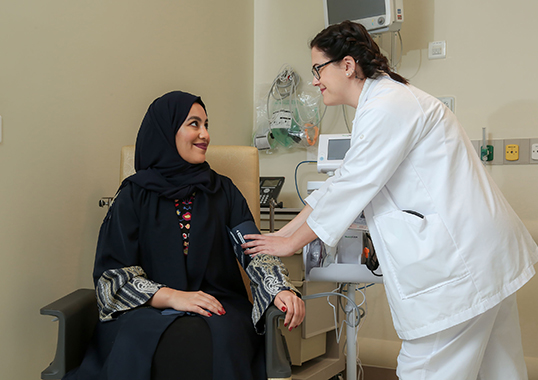
A conversation with Dr. Kathy Sienko, OBE, Chief Nursing Officer, and Dr. Joanne Cooper, PhD, RN, FAAN, Assistant Chief Nursing Officer, King Faisal Specialist Hospital & Research Centre
When you and your patient do not share a language, how do you make them feel heard? And what can nurses learn from colleagues whose training and experiences differ from their own?
We spoke with Dr. Kathy Sienko and Dr. Joanne Cooper of King Faisal Specialist Hospital & Research Centre in Saudi Arabia about the practical side of compassionate care, the challenge of leading diverse teams, and finding room to grow in a demanding profession.
1. Dr. Sienko, you’ve had quite an interesting career, spanning different industries, countries, and healthcare systems. What first brought you to Saudi Arabia?
Dr. Sienko: Curiosity is what brought me to Saudi Arabia, and service is what has sustained me. I first came for a three-day consulting opportunity. At the time, most of what I knew about the country came from the news, and I wanted to see it for myself.
Curiosity has shaped much of my career, including roles well beyond nursing. I've certainly worried about being out of my depth, but the chance to learn has usually outweighed that fear. Working in an unfamiliar setting reminds you not to assume you already understand someone else's experience. That's just as important at the bedside as it is in leadership.
2. You’ve spoken about the importance of curiosity and being open to new experiences. How has that shaped the way you lead nurses from different backgrounds and cultures?
Dr. Sienko: You have to stay curious and be prepared to listen. A team with different experiences brings ideas you might never have considered on your own. The leader's job isn't to have every answer; it's to make it possible for people to speak up, learn and contribute.
I've spoken about how unprepared I felt when I first stepped into leadership, and how much I learned through mistakes, mentors and coaches. We shouldn't assume that being a good nurse automatically prepares someone to lead. We need to invest in people, give them support and help them grow. For me, that is part of leading through service.
3. And that diversity extends to patients as well. How do nurses build trust and connect with patients when they don’t share a language? What have you learned about the importance of that connection?
Dr. Sienko: Language barriers are real, but connection does not begin and end with words. Nurses notice body language, expressions and changes in how someone responds. Those observations can prompt us to check whether a patient needs comfort, patience or help; they do not replace asking the patient or getting accurate clinical information.
One of our nurses, Victoria, who leads our dialysis unit, talks about how much we can communicate even when we don't share a language. She describes learning to recognize when patients need reassurance or comfort through their expressions and body language. She even bought a phone to help translate and communicate with patients while learning Arabic herself. To me, that's what compassionate nursing looks like: making the effort to meet patients where they are.
Dr. Cooper: For clinical discussions and consent, of course, we need appropriate professional interpreting support. But in the everyday moments of care, a patient can still sense whether we are present, patient and trying to understand. When we treat a patient from a different background, I’ve found it’s helpful to ask what helps them feel understood, rather than assuming we know. Research into patients' experiences shows how much relationships, compassionate interactions and attention to individual needs shape care.
4. Dr. Cooper, you’ve spent years researching compassionate care. What has your work taught you about what matters most to patients, particularly in their interactions with nurses?
Dr. Cooper: One lesson from my research is that good intentions do not automatically translate into a good experience for the patient. In research I co-authored on the experiences of people living with incurable cancer, the relationships and interactions people had with professionals were central to how they experienced care.
That is why it matters to ask what this specific patient needs, rather than rely on what we assume will help. We should pay attention not only to whether care is clinically sound, but also to whether people feel listened to and respected.
5. Building on that, nurses are often the first to notice when something could be done better. What helps them turn those observations into meaningful improvements in patient care?
Dr. Cooper: First, take those questions seriously. Nurses need time, encouragement and the skills to examine what the evidence shows, not just an invitation to come up with ideas.
My work on clinical academic careers and research development has shown how much mentoring, networks and opportunities matter. We also have to ask who gets access to those opportunities. When nurses can investigate a problem and share what they learn, research becomes part of improving everyday care rather than something separate from it.
6. Dr. Sienko, I’d like to come back to something you’ve spoken about before: finding purpose even when things are difficult. Nursing can be incredibly demanding. How do you help your teams maintain that sense of purpose?
Dr. Sienko: Purpose gives us direction, especially when life and work feel heavy. This April, I spoke at the 2026 ANCC Professional Development and Practice Summit about how purpose is sometimes revealed through the challenges we would never have chosen.
I also shared the thought that the grass is greener where you water it. For me, that is about noticing where we can grow and what we can influence. It is not a reason to dismiss the pressures nurses face or to suggest they should simply work harder.
We also have to keep our own cups filled. Leaders need to listen to what is making work difficult and help create the conditions in which nurses can flourish. Purpose matters, but so does practical support.
7. And finally, for both of you, if you could offer one piece of advice to nurses, wherever they are in their careers or wherever they’re practicing, what would it be?
Dr. Cooper: Stay curious about the person in front of you and about the evidence behind your practice. If you notice something that could be better, ask questions and seek out colleagues or mentors who can help you explore it. Small questions from everyday care can lead to meaningful improvements when nurses have the support to pursue them.
Dr. Sienko: I completely agree. It is so important to be curious. Also, be willing to serve. And do not assume you know everything.
Ask questions and pay attention to what matters to the person in front of you. Working in different settings has taught me that no one system has all the answers. We need to listen to patients, learn from colleagues and be prepared to change how we work when something can be done better. You will not always get it right the first time. The willingness to keep learning matters.